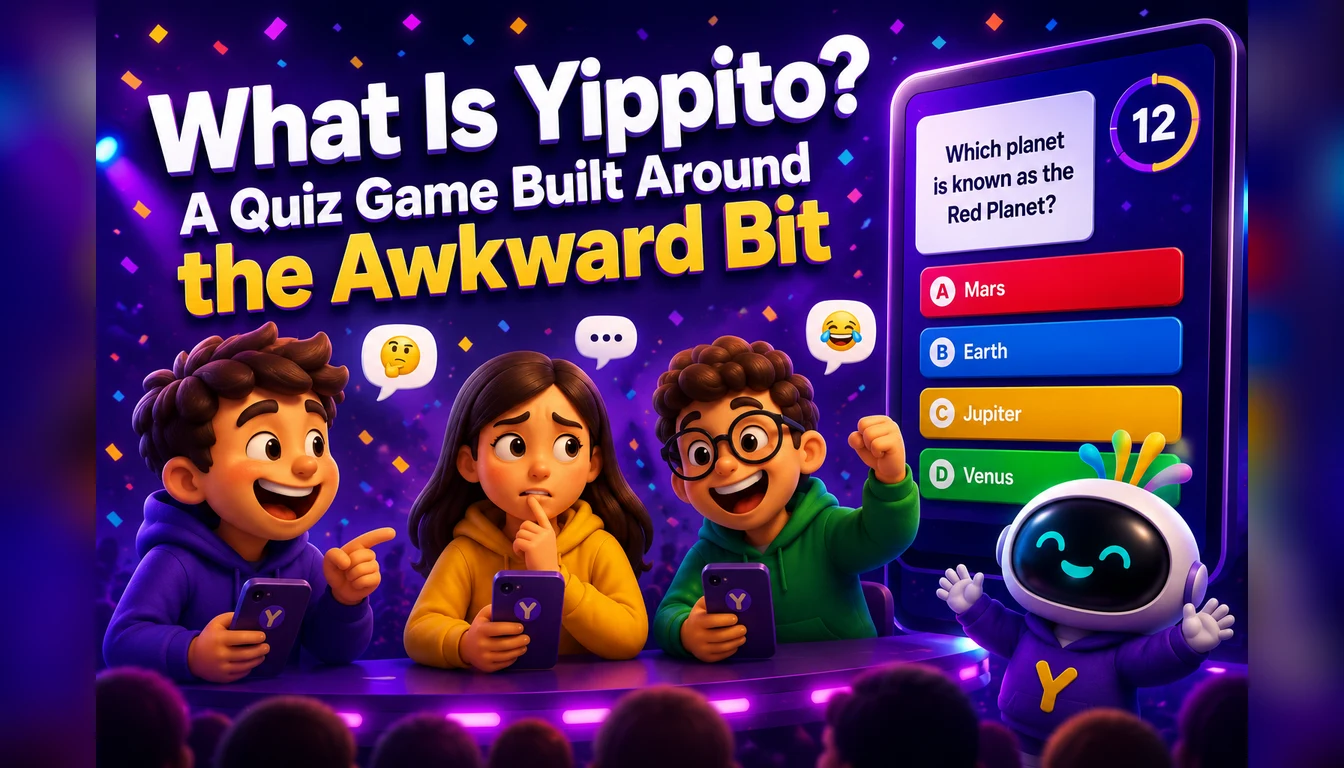
What Is Yippito? A Quiz Game Built Around the Awkward Bit
Guides · 6 min read
Guides
Hosting a live quiz is the fun part. Writing twelve decent questions at eleven at night is not. Yippito is built around that second part — and then gets out of the way so the game can be the game.
The format will be familiar: questions on one big screen, everybody answering on their own phone, a leaderboard that shuffles between rounds and makes people gasp. That bit is a solved problem. The bit that still eats an evening is producing the questions — and that is where most quiz nights, revision sessions and team meetings quietly die.
Start from what you already have
You rarely start from nothing. You have a topic in your head, a page of notes, an article you read, a chapter of a textbook, a video you want the class to watch. Yippito takes any of those and writes the first draft:
A topic.Type “the Roman Republic” or “90s one-hit wonders” and get a set of questions written from general knowledge.
Your own text. Paste your notes, a handout, a briefing document. The questions are drawn from what is actually in the text, not from whatever the model happens to know about the subject.
A web page. Give it a link and it reads the page first.
A PDF.Pick the file and it is read in your browser — the document never leaves your device.
A YouTube video. Point it at a video and the questions come from what is said in it.
The draft is a starting point, not a verdict. Every question, answer and explanation is yours to rewrite.
That last point matters more than it sounds. A generated quiz you cannot edit is a demo, not a tool. Yippito hands you a normal editor: change the wording, swap the right answer, delete the question that missed the mark, add two of your own. You are the author; the draft just saves you the blank page.
Eleven ways to ask a question
Twelve identical multiple-choice questions in a row is how a quiz gets boring. Alongside single-answer and multi-answer choices there are true/false, short typed answers, number answers with a tolerance range, and polls with no right answer at all — useful for opening a discussion rather than scoring one.
Then the ones that change the feel of the room: Puzzle Race, where players reassemble a scrambled image and the fastest scores most; Order Sequence, arranging events into the right order; Match Pairs; Pin on Image, where a tap closer to the target is worth more; and Image Hotspot, where the answer is a region of a picture. There is a longer tour of the question types if you want to plan a mixed set.
Any question can carry media: a picture, a YouTube clip trimmed to the exact seconds you want, or an uploaded video or audio file — also trimmed, so a music round plays the five seconds that matter instead of the whole song.
Then the game itself
When the questions are ready you start a live game and your screen shows a five-digit PIN and a QR code. Players open the join page, type the PIN or scan the code, pick a nickname, and they are in. No app, no account, no download — which is the difference between a room that plays and a room that spends ten minutes installing something.
From there the rhythm is question, answer, reveal, leaderboard. Answering correctly scores; answering quickly scores more. You can set the time limit per question, mark a late question as double points to keep the finish open, and attach an explanation that appears once the answer is revealed — the moment when people are most likely to actually take it in.
If you want the mechanics of running one in front of a real room, the step-by-step host guide covers the practical side: pacing, screen setup, and what to say between rounds.
Why a quiz is worth the effort at all
Because being asked a question is not just a way of checking what stuck — it is one of the more reliable ways of making it stick. Retrieving an answer from memory strengthens it more than reading the same material again, an effect studied for over a century and still routinely underestimated by the people it would help most. We wrote about that in the testing effect.
Which is the quiet argument for the whole thing: a game people want to play is the most painless delivery mechanism for something that genuinely works. The competition is the sugar. The retrieval is the point.
Who it is for
Teachersuse it as a lesson starter, an exit ticket or a revision round — built from the material the class actually covered, not a generic question bank.
Teams use it for onboarding, training recaps and the five minutes of a meeting that everyone remembers afterwards.
Friends and families use it for game night, where the topic is whatever your group would argue about anyway.
Try it on something small
The honest way to judge it is not to read about it. Take a page you already have — notes, an article, a chapter — and turn it into eight questions. It takes about two minutes, and by the end you will know whether the draft was any good, which is the only question that matters.
Make your first quiz.
Start from a topic, your notes, a link, a PDF or a video — then share the PIN and play.
Try it free