Beyond Multiple Choice: 11 Quiz Question Types That Keep Players Hooked
Guides · 8 min read
Guides
A quiz lives or dies on variety. Twelve identical multiple-choice questions in a row and the room goes quiet; mix the formats and the same content turns into a game nobody wants to end. Here are eleven question types and exactly when to reach for each.
Most quiz makers hand you multiple choice and leave it there. But the format of a question changes how it feels to answer — how much thinking it demands, how much drama it creates, how many different kinds of knowledge it can test. A good host treats question types like a DJ treats a setlist: build energy, vary the tempo, and save a twist for near the end.
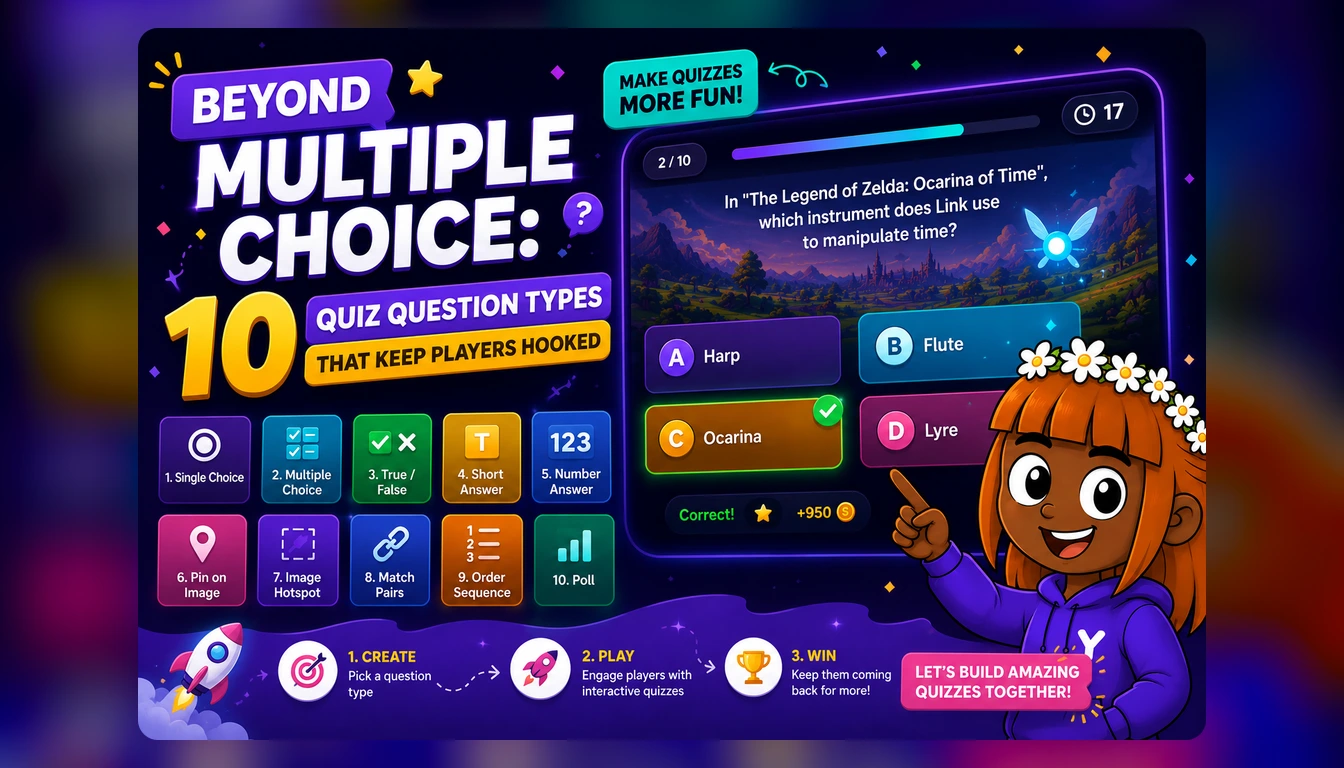
1.Single choice
The classic: one question, four options, one right answer. It is fast, instantly understood and works for almost anything, which is exactly why it should be your base — not your whole game. Great for warming up and for keeping the pace brisk.
2.Multiple correct
Same familiar layout, but now more than one option is right and players have to select every correct one. It is a small change that sharply raises the difficulty, because guessing no longer works — you cannot half-know the answer. Perfect for “which of these apply?” questions.
3.True / False
The quickest format there is. With only two options, true/false is all about speed and instinct, which makes it brilliant for building momentum early or firing off a rapid round. Write statements that are genuinely arguable and you get a satisfying split-second of doubt.
4.Short answer
Here players type the answer themselves — no options to pick from, no elimination, no lucky guesses. It is the toughest and most honest test of whether someone actually knows something, and it taps the same “produce it yourself” effect that memory research says makes things stick. Use it when you want to really separate the field.
5.Number answer
Players type a number instead of picking an option — how many, what year, what percentage. You set the accepted value and an optional tolerance, so “within 5” still counts. It is perfect for estimation questions where being close is the whole game.
6.Pin on Image
Show a picture and ask players to tap the exact spot — the country on a map, the muscle on a diagram, the odd one out in a crowd. The closer the tap lands to the target, the more points they score, so near-misses still count. It turns any image into a question.
7.Image Hotspot
A stricter cousin of Pin on Image: you define a zone, and a tap is right only if it lands inside it. Perfect for “click the verb in this sentence” or “find the mistake in this diagram” — a clean right-or-wrong on a visual.
8.Match Pairs
Players connect items into pairs — capitals to countries, terms to definitions, dates to events. Matching tests relationships, not just recall, and the drag-and-drop (tap-to-pair on phones) makes it feel like a game rather than a test.
9.Order Sequence
Give players a shuffled list and have them put it in the right order — historical events by date, the steps of a process, numbers by size. It is one of the best ways to test whether someone truly understands how things fit together, not just the isolated facts.
10.Poll
Sometimes there is no right answer — you just want the room’s opinion. A poll shows option tiles, collects everyone’s vote and reveals the live distribution, with nobody marked wrong and no points at stake. It is a brilliant ice-breaker, a temperature check mid-lesson, or a bit of fun between the scored rounds.
11.Puzzle Race
The showpiece. Players get a few seconds to memorise a picture — then it shatters into scrambled tiles and everyone races to rebuild it on their own phone. It is the one format where the whole room goes silent at the same moment, and it works with any image: a map, a painting, a diagram, a photo of the team.
And any of them can carry media
On top of the eleven formats, any question can carry an attachment: a picture, an audio clip, a video, or a YouTube link. The media plays on the big screen first, then the answers open — which is how you get “name that song” rounds, film-still rounds, or a true/false about the clip everyone just watched. Format and media combine freely, so the variety multiplies rather than adds.
The secret weapon: a double-points moment
On top of the formats, there is a lever every host should know about: flagging a single question as double points. Slot one near the end of the game and the whole leaderboard is suddenly up for grabs — a player in fourth can leapfrog to first on one answer. It keeps everyone trying right to the final question, because nobody is ever truly out of it.
A well-placed double-points question does more for tension than any amount of trick trivia. Nobody switches off when the game can still flip.
How to build a great mix
You do not need all eleven in every game. A reliable recipe for a ten-question quiz: open with a true/false to warm up, keep a spine of single-choice questions, add a short-answer or number question to test the keen ones, drop a poll in the middle for a breather, break it up with a Pin on Image or a Puzzle Race, and make the second-to-last question double points. That shape — easy start, varied middle, dramatic finish — is what keeps a room hooked.
Try the full toolkit
Every one of these — all eleven formats, media on any of them, and the double-points moment — is built into Yippito. Generate a quiz from any topic, mix in whatever formats fit, and host it live with everyone playing on their phones. Variety is the whole difference between a quiz people sit through and one they ask to play again.
Build a quiz with real variety.
Eleven question types, media rounds and double points — all in one place.
Try it free