How to Run a Buzzer Round in Your Quiz (No Buzzers Needed)
Guides · 6 min read
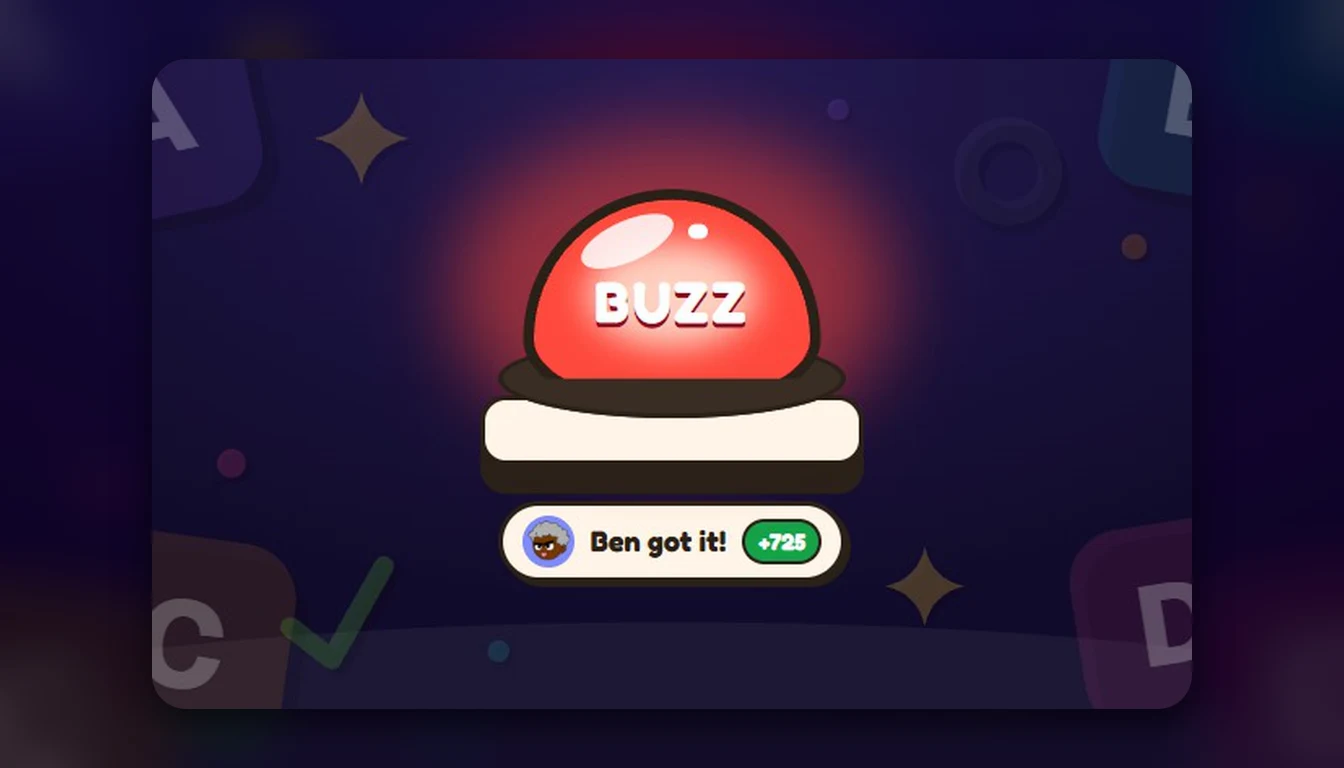
Every quiz has a moment where the room goes quiet and leans in. On television it is the buzzer: someone hits it, everyone turns to look at them, and for a few seconds one person carries the whole room. You can put that moment into any quiz night, classroom review or team social — and you do not need a box of buzzers to do it.
What a buzzer round is
In an ordinary round everyone answers at once and waits for the reveal. In a buzzer round the options stay hidden. Players race to press a single button, and the first to get there answers alone while everyone else watches. Get it right and the round is over. Get it wrong and the turn passes to whoever pressed next — who now knows one answer that it is not.
That last part is what makes it more than a race. Buzzing early is a bet: you might not know it yet, and a miss hands the question to the person behind you. Waiting is a bet too, because someone else will take it.
The questions that work best
A buzzer rewards the question people half know. If everyone knows it instantly, the round is decided by thumbs, not heads. If nobody knows it, nobody buzzes. Aim for the middle: a name on the tip of the tongue, a date you can narrow to a decade, a “which of these is not…” where two options look right.
Give it three or four options rather than two. With two, a wrong answer gives the next player the right one for free — the steal becomes a formality. With four, the second player still has a real decision to make after the first miss.
Keep the question short enough to read out loud. Half the fun is the room buzzing while the host is still reading, so the wording should not be a paragraph.
How many to use
Buzzer questions are a spice. One or two per round keeps them special; a whole round of them works as a finale, when people are warmed up and the scores are close. A quiz that is nothing but buzzers turns into a thumb contest, and the quieter players stop trying.
How the scoring works
Only one player scores on a buzzer question — the one who answers it right. In Yippito the first turn is worth the most, each turn after it a quarter less (never below half), and within a turn the faster answer scores more. A wrong answer scores nothing but never costs points, so buzzing is brave rather than reckless.
Players who never got a turn are not marked wrong. Being beaten to the buzzer is not the same as not knowing, so their answer streak carries on.
Hosting tips
Make the turn a moment. When someone buzzes, name them. The big screen shows who got there first with their clock running and who is waiting behind them — read it out, let the room react.
Same Wi-Fi if you can. The first press to reach the game server wins the turn, so phones on the venue’s Wi-Fi race on equal terms. A player on a slow mobile connection is at a small disadvantage, the same as with any online buzzer.
Let a miss land. A wrong answer is the best part of the round for everyone else. Pause on it before the next player’s turn — the struck-out option stays marked for them, and for the room.
Setting one up in Yippito
Make a quiz as usual — write it, or generate it from a topic, your notes or a link — then add a question and pick Buzzer. Write the question, two to four options and mark the right one. Buzzer questions are the one type you add by hand; the AI does not write them yet, which also means you choose exactly where the drama goes.
Host the quiz, put the PIN on the screen and let people join from their phones. When the buzzer question comes up, every phone turns into a big red button. The rest is the room. There is more about how it plays on the buzzer quiz game page, and the basics of running the night are in how to host a live quiz game.